
Today, I want to write about poetry. I did not accept this until Cate Hall’s Q&A, when she repeated some things I know. Some obvious things I’d apparently forgotten, for a moment.
So, let me share two poems with you. I wrote one last year, and one today. Each is followed with a bit of explanation about its form, and my writing process.
A Renga
I’ll tell you just one thing about the renga form, before the poem: each verse is only linked directly to its neighbours. There is no overarching narrative, but a sort of sausage-chain of images.
the glittering glints
of droplets on the branches
recount me your lovea forgotten sensation
of welcome fluiditythe ocean remains
in the spring, in the autumn
unfailingly vasta fish swims and swims and swims
and swims, never gaining groundthe soil is ready
for all of us to begin
to plant our footstepsin the garden she awaits
freedom from fertilitythis child can reckon
which flowers are most suited
for a funeralmy casket: inexpensive,
unbought, unbuilt, unimagineda mountain cabin
carefully made of wood planks
burns with the forestsome kilns stay hotter, longer,
to better fire potterythis jug is for milk
but the cows are at pasture
and won’t be back soonI know an animal’s mind:
an evergreen song of nowno-one can escape
the ecstatic turbulence
of unknown momentswhat do we chase in our lives
but beauty, which is right here?
Renga is a traditional Japanese form of alternating verses (ku) of 5-7-5 and 7-7 syllables (morae). The exact number of verses varied, but the standard was originally 100 (~1300s) and later 36 (~1600s). The form became less strict over time.
It was almost always written collaboratively, typically with 3-6 participants, guided and adjudicated by a master (sabaki). The most honoured participant would write the first verse, the hokku, which should be able to stand on its own; it’s the precursor to the famous haiku form.
There are some arcane rules (kigo) that govern which verses must contain references to specific objects (e.g. the moon, or cherry blossoms). There are also rules about how many verses in a row can focus on a given topic (e.g. love) before a shift has to happen.
The renga I’ve shared is heterodox: I wrote it solo, and it contains only 14 verses. I didn’t follow any strong thematic constraints, or rules about the moon appearing, or whatever. It took me an hour or two to write and edit, on the day I first learned about renga (14 May 2025). It’s the only one I’ve written so far, aside from a few scattered verses with friends. I did edit the hokku, when writing this post. Here’s the original:
the glittering glints
on droplets on the sidewalk
recall me my love
Do you prefer the new one?
A nice thing about renga: it lets you practice in bite-size pieces which are not totally unhinged from each other. The thematic constraint between adjacent verses binds the poem together, but doesn’t force you to think hard about where you are going. This seems like good practice that’s specific to generating imagery and keeping it locally coherent.
A Sonnet
Here’s one I wrote this evening.
At times I grasp my pen to summon Muses;
instead I’m met by gasping, drowning Choice,
which struggling to stay floating, self-abuses;
so ends my song before I’ve found my voice.Now voiceless I am subject to your leering.
Your judgment is foretold, a muffled scream
that fills my future — all-conjoining fearing,
a stifling stillness, this ensqualored dream.For what I know, and what I can accept,
stay silent in me ‘til I hear you speak
the obvious. Oh, were I more adept,
I’d spend less effort keeping myself weak.When I release this raft to which I cling,
I listen to your love, and start to sing.
This morning, we went to Muir Woods. I love forests, and Muir Woods is a forest.
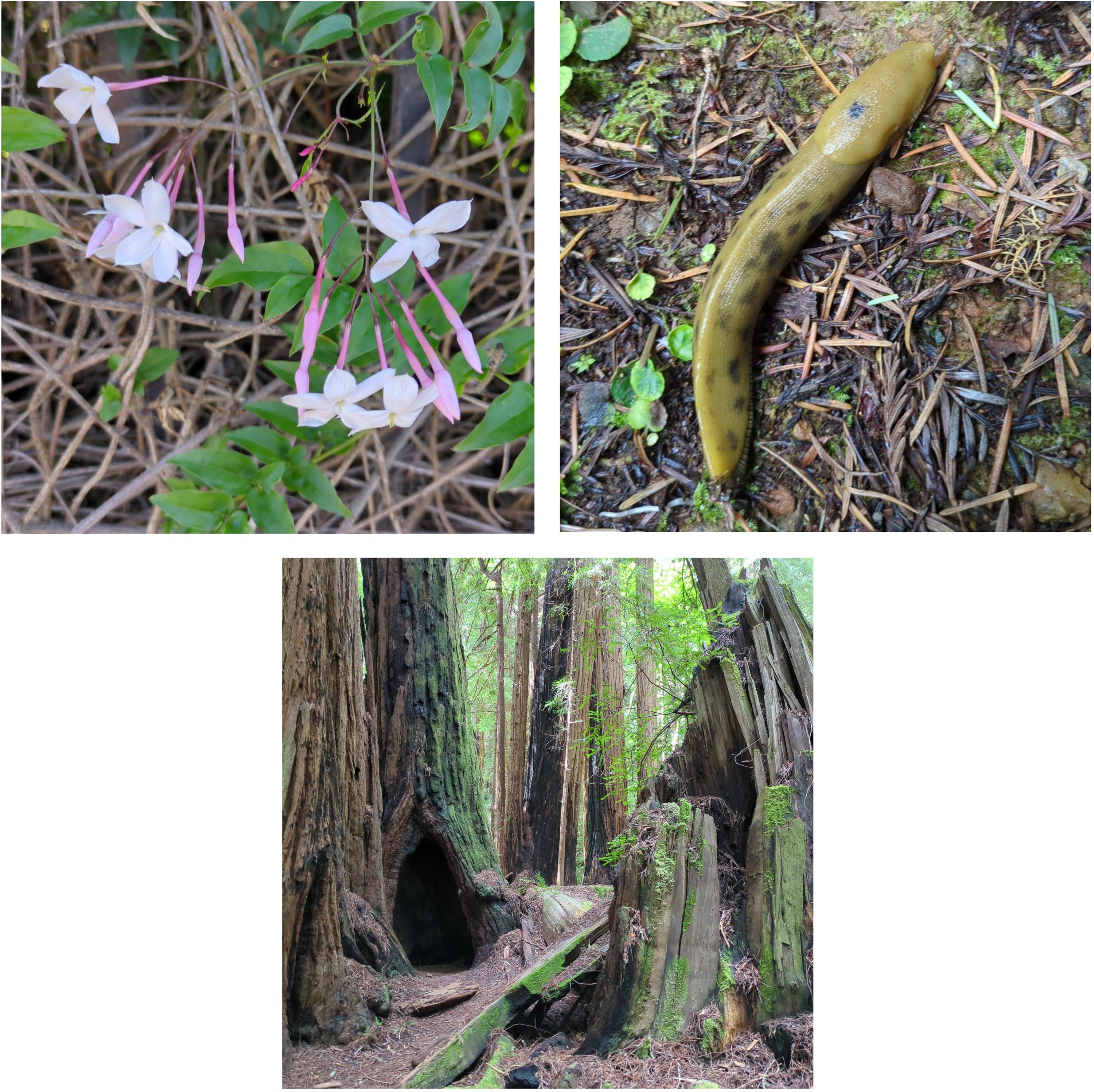
I loved it there. When I got back, I went insane. For the first time since I got to Inkhaven, I went to my room, to write at the desk there, alone. It was covered in my things, and I had to move them aside. I sat there for 20 minutes trying to write a high-effort thing before I became too agitated to stay. I left and walked around the grounds. I saw people sitting around and talking, enjoying themselves. I wasn’t enjoying anything. After 15 min of this, Cate Hall’s Q&A started, so I went to listen to that, because I like her writing. I was not happy to be there.
By the end I was feeling better. I knew what I actually wanted was to be in the forest, still. But writing poetry is kind of like that. I knew I wanted to write poetry.
Writing 500 words of poetry is difficult, but I already had the renga finished, and conq rightly advised me to also write about my process.
How did I write the sonnet? I started by vibing out the line-ending rhymes, the vertebrae of the imagery I felt I wanted. Here: screaming-dreaming, leer-fear, choice-voice, cling-sing. I also knew I wanted the imagery to be musical. Then, I thought about how to arrange the backbone, while attempting to sound out some lines in my head. This gradually transitioned into writing out the lines more systematically, top-to-bottom, though I also quickly formed and held onto a sense of the final couplet, which helped to bind together the narrative of the poem as I wrote the intervening lines. Finally I reviewed it and thought about key phrasing choices. Here, I originally had “music” and “self-abusic”, but one unorthodox word (“ensqualored”) seemed enough for this poem.
There are several kinds of sonnet, but this is a Shakespearean sonnet, which is the kind I tend to write. It consists of three quatrains with alternating rhymes, followed by a single rhyming couplet. So, 14 lines total. The meter is of course iambic pentameter.